Workshop Recordings Available for Purchase
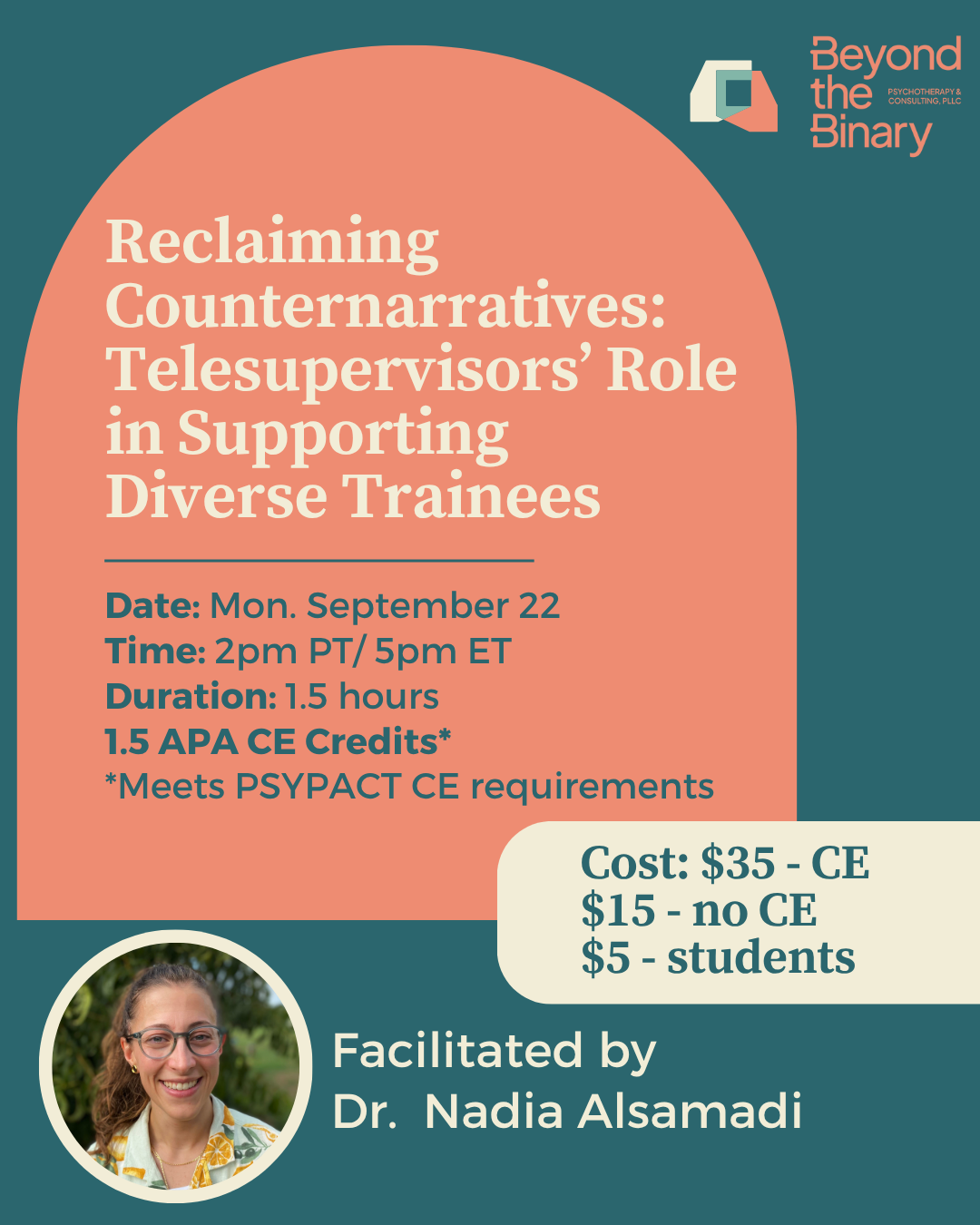
Reclaiming Counternarratives: Telesupervisors’ Role in Supporting Diverse Trainees
HOSTED BY: The Multicultural Counseling Institute
Recording Available for Purchase:
$35 - 1.5 APA CE Credit & PSYPACT
"This was the best training I've been to in years" -Live Session Attendee
"Enlightening, reflective, energizing, supportive, and truly engaging. Love the connection with attendees and the care and interest in answering questions." -Live Session Attendee
Workshop Description
White Supremacy, systemic oppression, and Eurocentrism have shaped and pervaded psychological science, practice, and training (Guthrie, 2004; Mullan, 2023). Training programs model trainee development based on a master narrative constructed from this lens. “A master narrative is a script that specifies and controls how some social processes are carried out,” and “[acts] to universalize and cast dialogues in binary, contrasting categories that support the maintenance of dominant groups” (Stanley, 2007, p. 14). Internalizing a master narrative that does not align with their cultural experiences and worldview can lead marginalized trainees to have difficulty developing a positive clinical identity, and feel inadequate, confused, and without agency in the training process (Brunsma et al., 2017; Denu, 2023; Lund et al., 2014; Lykins, 2021; McLean & Syed, 2016).
Supervisory relationships are foundational for developing trainee skill, practice, and clinical identity; thus supervision is a critical site for mitigating the internalization of the master narrative for marginalized trainees. Supervisors are in a unique position to support trainees in developing counternarratives, which seek to identify, deconstruct, and challenge the master narrative through creation of an alternative narrative grounded in their own perspective, culture, and values (Stanley, 2007). In the current digital landscape, supervision is often provided via telehealth or hybrid methods. As such, this program will present strategies for telesupervisors to (1) develop a strong working alliance with marginalized trainees; (2) address the impact of master narratives on trainees’ clinical identity, performance, and well-being during telesupervision; and (3) collaborate with trainees to develop personal counternarratives grounded in their strengths and resistance.
Learning Objectives
(1) Define master narrative and counternarrative, and explain their relevance to telesupervision of psychology trainees.
(2) Identify strategies for developing a strong supervisory relationship in the telesupervision setting.
(3) Address the impact of master narratives on trainees’ clinical identity, performance, and well-being during telesupervision.
(4) Identify ways to collaborate with trainees to develop personal counternarratives grounded in their strengths and resistance during telesupervision.